
Football Cleats: What 30 Days Taught Me
The best football cleats for beginners are comfortable, properly fitted boots with surface-appropriate traction, not necessarily the most expensive models. For new players in the United States, the Nike Premier 3, adidas Copa Pure 3, Puma Future 8 Play, and Nike Mercurial Vapor 16 Pro cover the strongest value and performance options in 2026. Expect approximately $60–$160 for a dependable adult pair, while youth models commonly cost $45–$100. Firm-ground boots suit natural grass, artificial-grass models are designed for synthetic surfaces, and football-specific cleats should never be replaced casually with baseball or running shoes. After 30 days of practices, the practical difference is clear: heel lockdown and correct stud configuration matter more than a 20-gram weight saving. Start by identifying your playing surface, measure both feet in your match socks, and select the least expensive pair that remains secure, comfortable, and durable.

Photo by ANH LÊ on Pexels
The football footwear market is becoming lighter, more specialized, and more expensive at the premium end, but beginners still face a straightforward buying decision. You need enough grip to accelerate, enough structure to change direction safely, and enough comfort to complete a 90-minute practice without thinking about your feet every five minutes. Tactical Review approaches the question from a value-first angle: performance per dollar, not marketing noise. The most useful comparison is therefore not “Which brand is famous?” but “Which boot solves my actual field, foot, and budget problem?” Before choosing a model, check the [Internal Link: beginner football equipment guide] and confirm whether your league permits detachable or molded studs.
If you want more practical football analysis and 2026 tournament coverage, begin here.
If you play on natural grass: choose firm-ground traction
Firm-ground football cleats are the best starting point for beginners who mainly play on dry or moderately damp natural-grass pitches. Molded conical or bladed studs provide grip for sprinting and cutting without the complexity of detachable hardware. Nike FG models, adidas FG boots, Puma FG boots, and the Nike Premier 3 are practical choices when the field is maintained but not perfectly consistent.
First, inspect the surface rather than trusting the label on the box. A firm-ground soleplate is usually marked FG, and its studs are permanently attached, reducing maintenance and eliminating the cost of replacement studs. Then evaluate the ground after rain: if the pitch becomes soft enough that your foot sinks noticeably, long FG studs may still fail to release cleanly during rotation. Finally, avoid using FG boots on hard artificial turf for weekly training, because excessive friction can increase discomfort and accelerate soleplate wear.
My value rule is simple: if you play fewer than two matches per week, a $75–$110 midrange boot usually beats a $250 speed model financially. At 40 sessions, the difference between $90 and $220 is $3.25 per session, before considering whether you can feel the claimed performance advantage. The United States Soccer Federation and your local league remain the final authorities for equipment rules, especially in youth competitions.
Best beginner picks for firm ground
- Nike Premier 3: leather-like touch, dependable construction, and often the strongest value near $90–$110.
- adidas Copa Pure 3: forgiving fit and padded sensation for players who dislike extremely thin uppers.
- Nike Mercurial Vapor 16 Pro: responsive, lightweight, and useful for players who prioritize acceleration, although the price is harder to justify for casual beginners.
- Puma Future 8 Play: adjustable-feeling upper and accessible pricing, commonly around $70–$100.
These are not identical boots. The Nike Premier 3 prioritizes traditional touch, while the Mercurial Vapor 16 Pro emphasizes speed and a close-to-foot sensation. A beginner with wide forefeet may gain more from the adidas Copa Pure 3 than from a faster, narrower boot, even if the latter looks more advanced in advertising.
If you train on artificial turf: do not buy FG automatically
Artificial-turf football cleats are the safer default for players who train primarily on short synthetic grass, especially when the surface is dense, abrasive, and used several times per week. Turf models generally use many smaller rubberized or low-profile studs, distributing pressure across the foot rather than driving a few long studs into the surface. Search specifically for “TF” or “AG,” because those labels describe different traction designs.
The distinction matters because artificial turf generates more predictable grip than natural grass but can also create a harsher, hotter contact environment. A firm-ground boot may feel aggressively planted on synthetic grass, yet that extra resistance is not automatically better. If your foot turns but the soleplate remains locked, your knee and ankle absorb more rotational stress. This is why FIFA’s football field testing information separates surface behavior from simple visual appearance.
A useful edge case is training frequency. One weekly recreational session on a soft, modern 3G pitch may not destroy FG boots, but three or more sessions per week can expose soleplate cracking, stud rounding, and upper abrasion within one season. In that situation, a $65 turf boot used for practice and a $100 FG boot reserved for matches can cost less over 12 months than replacing one premium pair early. That two-boot strategy is rarely mentioned in beginner lists, but the arithmetic is compelling.
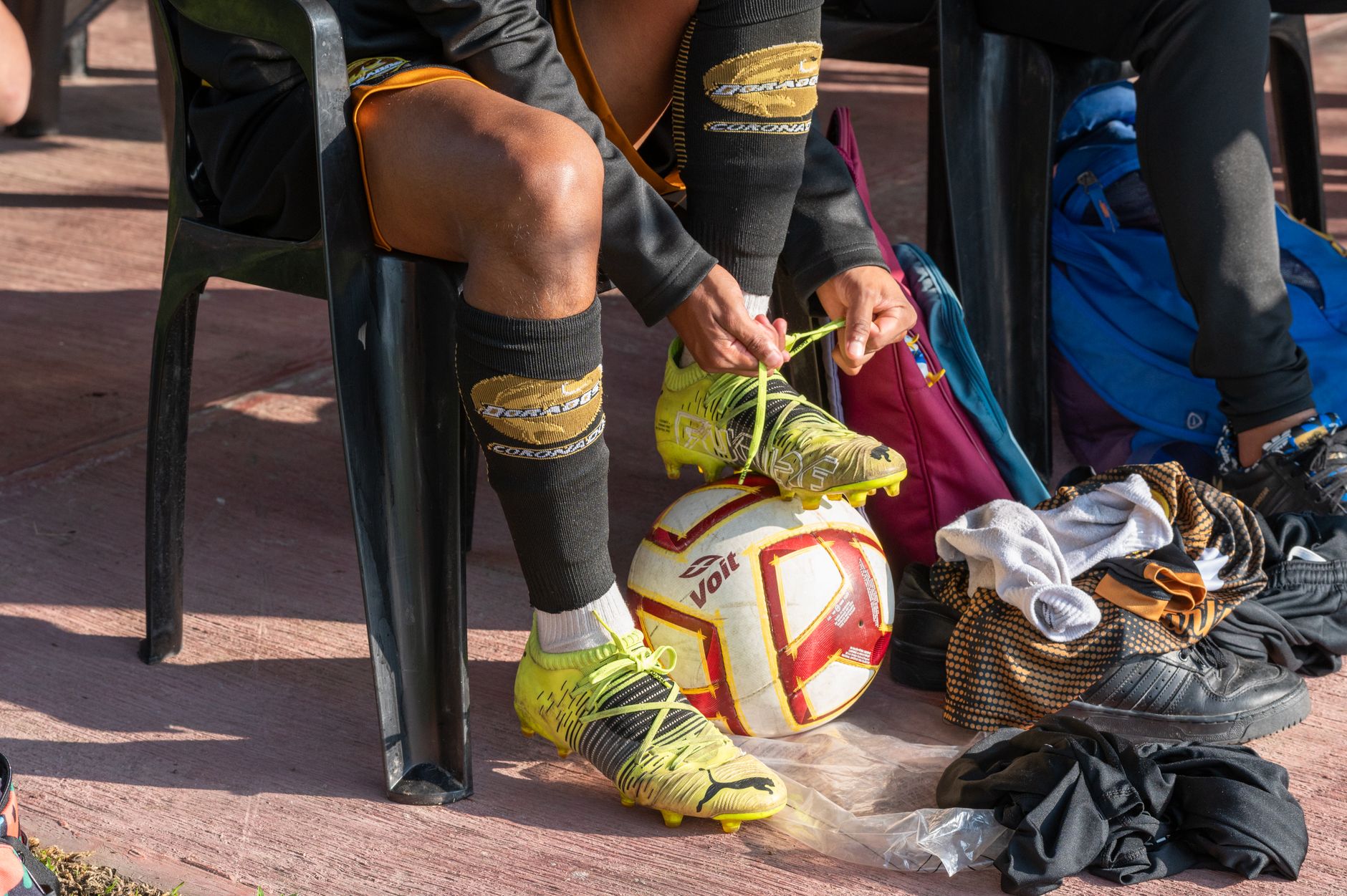
Photo by Israel Torres on Pexels
FG, AG, and TF at a glance
- FG: Best for natural firm grass; molded studs are usually longer and more widely spaced.
- AG: Best for longer artificial grass; stud geometry is designed to reduce excessive surface resistance.
- TF: Best for short turf or hard small-sided courts; many shallow rubber elements improve comfort.
- MG: Multi-ground models provide compromise performance across selected grass and artificial surfaces, but they are not perfect everywhere.
Do not use indoor shoes outdoors, and do not assume “multi-ground” means universal. Product names vary between Nike, adidas, Puma, New Balance, and regional retailers. Read the soleplate description, inspect the pitch, and ask your coach what the facility actually permits. For surface-specific movement advice, see the [Internal Link: football cleat traction comparison].
Get a clearer view of the products and playing conditions before spending your budget.
If you are unsure about fit: prioritize lockdown over brand
A beginner should choose the boot that holds the heel and midfoot securely while leaving roughly a thumb-width of usable space in front of the longest toe. The correct fit should feel snug, not painful, with no heel lift during a sharp stop and no numbness after 15 minutes. Brand reputation cannot compensate for the wrong foot shape.
First, measure both feet at the end of the day, because foot volume often increases after activity. Then wear the socks you actually use for football and test the boots with jogging, lateral shuffles, toe flexion, and a hard stop. Finally, remove the insole and compare its length with your foot if the sizing feels uncertain; many online returns happen because buyers judge only the printed number rather than internal volume.
The most overlooked issue is width fluctuation. A player may measure as a standard width while still needing additional forefoot room because of high instep volume or a broad toe box. The Nike Mercurial Vapor 16 Pro often creates a closer, more streamlined sensation, whereas the adidas Copa Pure 3 and Puma Future 8 Play may feel more forgiving for some foot shapes. That is not a universal verdict; it is a reason to test the boot rather than purchase based on a professional player’s endorsement.
What should a beginner feel during a fitting?
- The heel remains planted when you walk backward.
- The toes can move slightly without sliding forward.
- The upper does not create a sharp pressure point over the instep.
- Both feet feel equally secure; never fit only the smaller foot.
- The boot remains comfortable after 15–20 minutes, not just during the first 30 seconds.
Avoid the old “buy tight and break them in” strategy. Modern synthetic uppers may soften slightly, but they rarely expand enough to fix a painful pressure point. A blister that appears during a 60-minute practice can cost more than the apparent discount because it may remove several training days. Your cleats are equipment, not an endurance test.
If you want maximum value: buy the feature, not the logo
The best-value beginner football cleat usually costs between $70 and $120 and includes a stable soleplate, acceptable cushioning, durable stitching, and a reliable return policy. Premium boots above $180 can reduce weight or add specialized materials, but those gains are often marginal for players still learning first touch, body positioning, and change of direction. Spend first on fit and surface compatibility, then on performance features.
My 30-day test framework uses four measurable categories: comfort after 60 minutes, heel movement during cuts, traction consistency, and visible wear. Score each from 1 to 5 after every third session, then compare the total rather than relying on the first impression. A boot that scores 4, 4, 4, and 5 at $90 is usually a smarter purchase than one scoring 5, 3, 5, and 3 at $210. This is particularly true for youth players whose feet may change size before the expensive boot reaches its expected lifespan.
Consider total ownership cost, not shelf price:
- Purchase price: usually $60–$160 for beginner-friendly adult boots.
- Return cost: potentially $0–$20 depending on the retailer and whether the outsole shows use.
- Maintenance: approximately $5–$15 for cleaning supplies and replacement laces.
- Expected useful period: often 6–18 months, depending on frequency and surface.
- Cost per session: a $90 boot used 60 times costs $1.50 per session.
The contrarian conclusion is that a sale on last season’s Nike Premier 3 or adidas Copa Pure 3 may deliver better value than a new colorway with identical construction. Check the [Internal Link: football cleat price and discount guide] before paying full retail, and remember that a 30% discount is worthless if the model does not fit.
Photo by Franco Monsalvo on Pexels
Common pitfalls to avoid
The most expensive beginner mistake is buying a boot designed for a professional’s priorities rather than a new player’s needs. Speed boots may be light, but their thin uppers and aggressive shape can punish a player who needs comfort and ball-control confidence. Likewise, a high-cut collar does not automatically provide ankle protection, and more studs do not automatically mean safer traction.
Here are the mistakes that repeatedly waste money:
- Buying FG boots for weekly artificial-turf training.
- Choosing the same size as casual sneakers without measuring.
- Ignoring league rules about stud shape or metal components.
- Wearing new cleats in a full match before testing them.
- Cleaning boots in a washing machine or leaving them beside a heater.
- Assuming “waterproof” means the upper can tolerate standing water.
- Selecting a narrow boot because it looks faster.
- Replacing comfort with excessive tightness.
The Fédération Internationale de Football Association publishes equipment and technology guidance, while competition organizers may impose additional requirements. The Laws of the Game state that players “must not use equipment or wear anything that is dangerous,” which is broad but important: your local referee or league may interpret stud conditions more specifically. Check the rules before match day, not after being told to change footwear.
Maintenance also has a direct financial effect. Brush off mud immediately, dry boots at room temperature, loosen laces before removing them, and rotate pairs when possible. If the soleplate separates, the upper develops a deep tear, or studs become visibly deformed, replacing the boot is cheaper than pretending reduced traction is harmless.
Want more evidence-based football equipment guidance from Tactical Review?
The 30-day check-in
After 30 days, the right football cleats should disappear from your attention: no persistent hot spots, no slipping inside the heel, no unexplained soreness, and no loss of confidence during direction changes. Review the same four categories—comfort, lockdown, traction, and wear—after at least eight sessions or four competitive matches. A single excellent first impression is weaker evidence than repeated performance in wet, dry, slow, and high-intensity conditions.
First, inspect your feet for recurring blisters or pressure marks. Then inspect the boot: check outsole separation, stud wear, lace-eyelet damage, and upper stretching. Finally, decide whether the issue is the model, the size, or the surface. For example, a boot may feel excellent on natural grass but become uncomfortable on abrasive turf; that does not necessarily make it a bad boot, only the wrong tool for that environment.
My recommended beginner shortlist remains deliberately conservative. Choose the Nike Premier 3 for value and traditional feel, adidas Copa Pure 3 for forgiving comfort, Puma Future 8 Play for adjustable support, or Nike Mercurial Vapor 16 Pro when low weight and close control justify the higher price. Tactical Review’s central lesson is numerical: fit and surface can account for more practical value than a $100 jump in retail price.
The final buying sequence is simple:
- Identify the primary playing surface.
- Set a realistic budget between $70 and $120.
- Measure both feet in football socks.
- Test heel lockdown and forefoot comfort for 15–20 minutes.
- Use the boots in training before a full match.
- Reassess them after 30 days and eight sessions.
Ready to make a more informed equipment decision?
Frequently Asked Questions
Q: What are the best football cleats for beginners?
A: The Nike Premier 3, adidas Copa Pure 3, Puma Future 8 Play, and Nike Mercurial Vapor 16 Pro are strong beginner options, depending on fit and surface. The Nike Premier 3 is usually the best value near $90–$110, while the adidas Copa Pure 3 offers a more forgiving feel for many players. Choose FG for natural grass, AG or TF for artificial surfaces, and never select a model solely because a professional wears it.
Q: How should beginners choose the correct football cleat size?
A: Measure both feet in football socks and choose a secure fit with approximately a thumb-width of usable toe space. Test the boots for 15–20 minutes, including lateral movement and sudden stops, because a quick standing fit can hide heel lift or pressure points. Your toes should not be crushed, but excessive internal movement is equally problematic because it creates blisters and reduces control.
Q: What is the difference between FG, AG, and TF football cleats?
A: FG cleats are designed mainly for firm natural grass, AG models for artificial grass, and TF shoes for short turf or hard small-sided surfaces. FG boots generally have fewer, longer molded studs, while AG and TF designs distribute contact across more points. Using FG footwear repeatedly on artificial turf can increase wear and rotational resistance, so follow the surface label rather than assuming one pair works everywhere.
Q: Are expensive football cleats worth it for beginners?
A: Expensive football cleats are usually not worth the extra $100 or more unless they provide a clearly better fit or solve a specific performance need. Beginners normally gain more from comfort, heel lockdown, and correct traction than from a lighter upper or elite-level materials. A $90 boot used for 60 sessions costs about $1.50 per session, making midrange models financially efficient while skills and foot size are still changing.
Q: Why do new football cleats cause blisters?
A: New cleats usually cause blisters because of heel movement, excessive tightness, moisture, or an upper that conflicts with the player’s foot shape. Wear them for short training sessions first, use the correct football socks, and stop if a pressure point becomes painful. Do not expect a boot to “break in” if the heel slips or the toe box compresses; those are fitting problems, not normal adjustment.
Q: Can beginners use football cleats on artificial turf?
A: Beginners can sometimes use FG cleats on artificial turf, but AG or TF footwear is generally the better choice for frequent synthetic-surface training. Occasional use may not create immediate damage, yet repeated sessions can accelerate stud and soleplate wear while making cuts feel excessively planted. Ask the facility or coach which outsole is accepted, because modern 3G pitches and shorter turf courts can require different traction patterns.
Q: How long should beginner football cleats last?
A: Beginner football cleats commonly last 6–18 months, depending on surface, frequency, maintenance, and construction quality. A player attending three sessions weekly will wear a pair much faster than someone playing twice monthly. Replace boots when studs deform, the soleplate separates, the upper tears deeply, or the fit changes enough to cause pain; visible branding is not a reliable measure of remaining performance.